Supply Market Segmentation Tools
Numerous tools are used in segmentation of market for suppliers.
a) Supplier referencing matrix
b) Supplier account strategies
c) Supply positioning
d) Pocket Approach
a) Supplier Referencing matrix
The buyer needs to be aware that suppliers will also be assessing the true cost and, therefore, profitability of doing business with is customers for a specified product or service. In addition to the direct costs of production, all other costs incurred in winning and retaining the business are calculated and aggregated.
The matrix below plots the attractiveness of the customer to the supplier (y- axis) against the relative value of customer (x-axis). ‘Attractiveness’ is principally profitability or ‘margin’ but also includes other considerations as:
- Prompt payment
- Opportunity for growth
- Association with a high profile customer name
- Stable or predictable requirements with good forward planning
- An account that is easy to service (as opposed to a ‘difficult’ customer)
- Mutually trusting relationship
- Long life expectancy
- Simple and straightforward systems.
From the figure it can be seen that when the relative value is significant and the attractiveness is high, then the supplier’s strategy will be to defend and, if possible, develop the business. Conversely, when the attractiveness is low and the value is small, then the supplier is likely to adopt a strategy involving selective withdrawal. It is, therefore, important for buyers to determine as far as is possible how their business is perceived by the supplier.
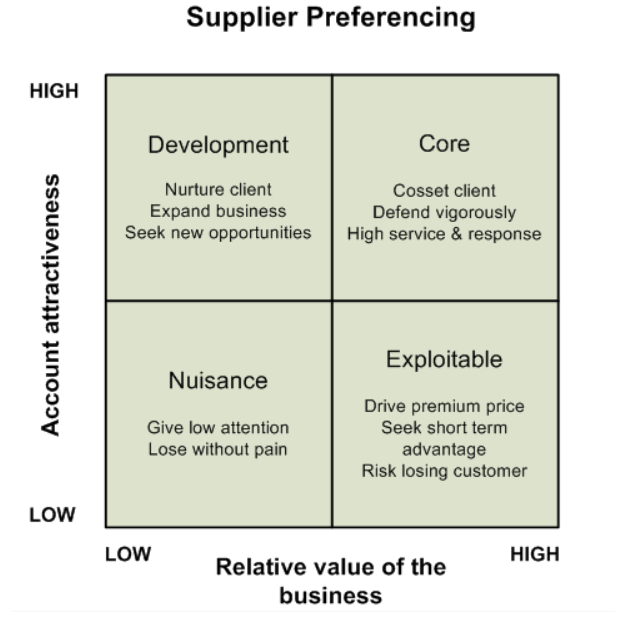
Figure 2
b) Supplier account strategies
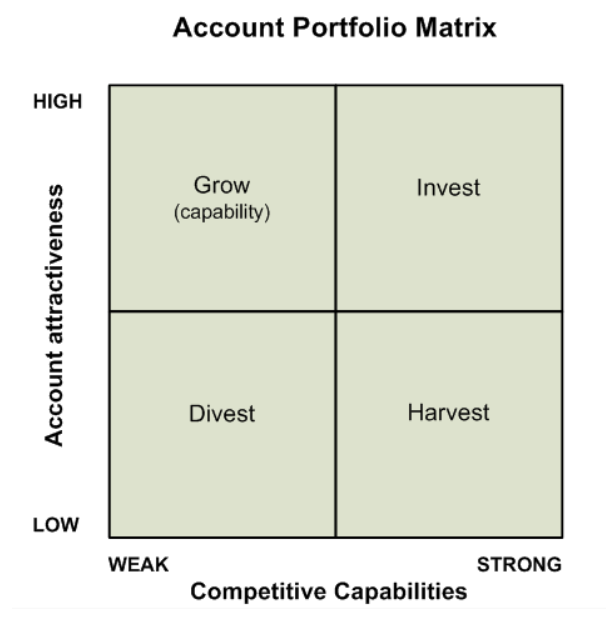
In these strategies, the account attractiveness is plotted against the supplier’s capability relative to competitors, putting into consideration factors that may drive change in the relative value of the business. This is presented in the figure below
c) Supplier Positioning
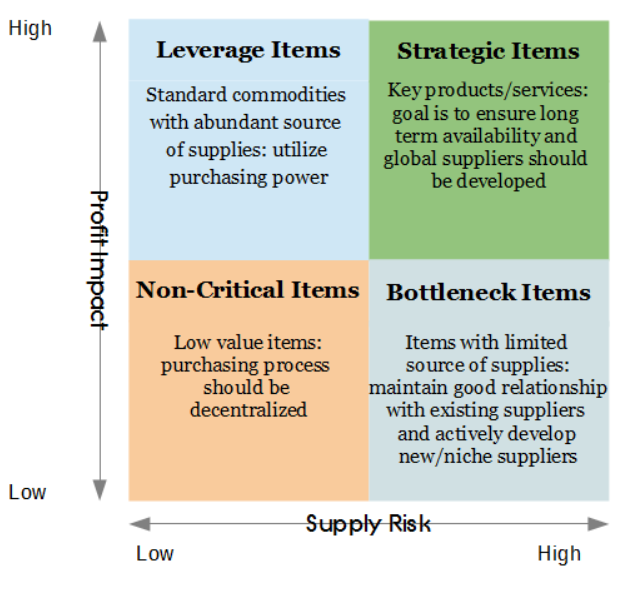
This strategy is also referred to as Kraljic Matrix, or Purchasing Portfolio Matrix or Supply Chain Portfolio Matrix. It is a method developed by Peter Kraljic in 1983. It is used to create a purchasing portfolio by segmenting items (products or services) into four dimensions. The result is that purchasing professionals can prioritize buying activities based on profit impact and level of risks involved.