
Michael Porter’s Five Forces Model of Competition
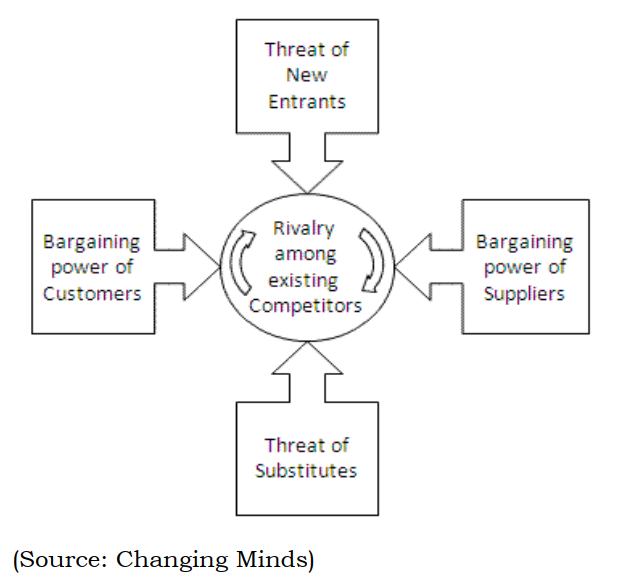
Professor Michael Porter developed a framework which suggests that competition in an industry is dependent on five forces within the industry’s environment.
Existing competitors deter new players from entering a market because this will make the market more competitive in the following ways;
The model is illustrated below:
1. Threat of New Entrants
Existing competitors deter new players from entering a market because this will make the market more competitive in the following ways;
- Penetrating into the market.
- Aiming to get a share in the market.
- Increasing the supply of products.
- Increasing costs of production.
The existing competitors will enforce barriers to entry to reduce the attractiveness of the market. Such barriers to entry include; economies of scale, high capital investment, product differentiation, brand identity, switching costs, control over distribution channels, control over a natural resource, government policies.
2. Threat of Substitutes
Buyers are able to switch to alternative products if they are more attractive in terms of price, quality, innovation and availability. This makes the substitute products a threat to the existing competitors.
3.Bargaining Power of Suppliers
If suppliers have more power in the market, prices in the market will increase. Suppliers can have more power if;
i. They are fewer in number or larger in size than the buyers.
ii. There are few or no substitutes for the supplier’s products.
iii. The buyer does not have a big share in the supplier’s business.
iv. The buyer relies heavily on the supplier’s products.
v. The switching cost for the buyer is high.
vi. There is a possibility for the supplier owning or controlling the buyer’s business (forward integration).
4. Bargaining Power of Buyers
If buyers have more power in the market, they will force prices to come down, insist on better quality or frustrate the competing suppliers. Buyers can have more power if;
i.They are fewer in number or larger in size than the suppliers.
ii. The amount they purchase is more than the supplier’s earnings.
iii. There are substitute goods allowing them to switch suppliers.
iv. There is a possibility for the buyer owning or controlling the
supplier’s business (backward integration).
5. Rivalry Among Existing Competitors
Rivalry among competitors in a market varies in intensity. Some competitors may collude with each other while others may aggressively compete on factors like innovation, price or advertising.
The intensity of rivalry is more when;
i. Competitors are equal in size, ability, potential, etc.
ii. The industry growth is slow.
iii. There is no product differentiation.
iv. The costs of production are high.
v. The barriers to exit are high e.g. reputation damage, cost of staff redundancies, difficulty disposing assets.